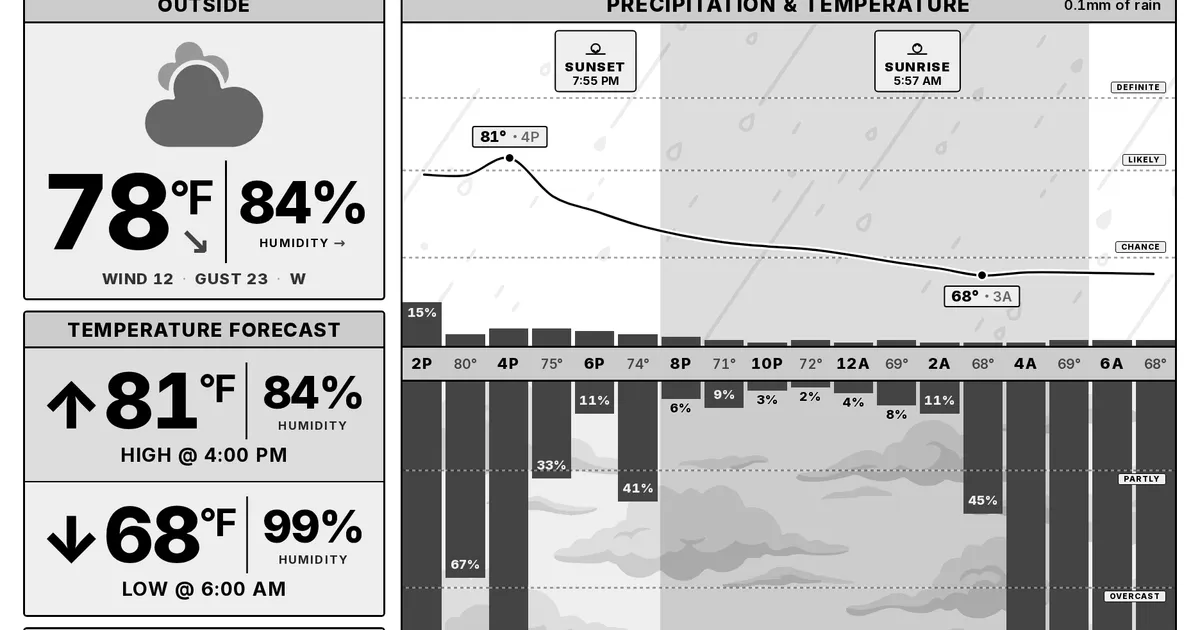
trmnldash renders dashboards for TRMNL e-ink devices. TRMNL’s Image Display plugin just polls a URL for a PNG, so this is the other half: a server that composes panels, renders them to a device-specific image on a schedule, and serves them. One process can host several dashboards at once, each on its own refresh cadence, so a one-minute weather panel and a ten-minute calendar panel share the same container.
How it works
- Render pipeline. Each panel is a single Jinja2 template with inline CSS, screenshotted by headless Chromium, then palette-quantized with Pillow down to the panel’s greyscale depth (down to 4-bit / 16 greys).
- Composable panels. A landscape weather panel, a portrait Google Calendar agenda, and a compact weather panel compose in any combination via a YAML layout tree of vstacks and hstacks.
- Pluggable weather sources. Open-Meteo (no key, global) or the US NWS sit behind one protocol, with an optional Home Assistant integration that prefers real indoor/outdoor sensor readings over the API’s model estimate.
- Device-aware output. A device profile carries size, palette, and rotation; the same layout targets a large TRMNL X or a smaller TRMNL OG.
The feel
The unusual part is that there’s almost nothing to interact with. It’s an ambient panel you glance at on the way past, not something you operate - you configure it once in YAML and then never touch it again. So every design call is about what reads at arm’s length on a slow, 4-bit greyscale screen: solid silhouettes instead of anti-aliased edges that turn to mush under quantization, hand-picked greys that survive the palette crush, and density-shifted chart fills so a bar stays legible whether it lands in a bright or dark region of the panel. Composing the panels is a YAML tree of vstacks and hstacks because laying out an ambient display is a decision you make once, not something you drag around. It’s built to be seen, not used.
Notes
Designed around the 4-bit target - solid silhouettes over semi-transparency, hand-picked greys that survive quantization, and density-shifted chart fills that stay legible in both day and night regions of the panel. The dashboards it drives are served behind per-dashboard secret paths, so no live instance is public.
snapshot
reflects trmnl-weather-dash@9c9cec1captured Aug 12, 2026