Ramble
Dictate rambling voice notes; an agent composes them into a post in your own words.
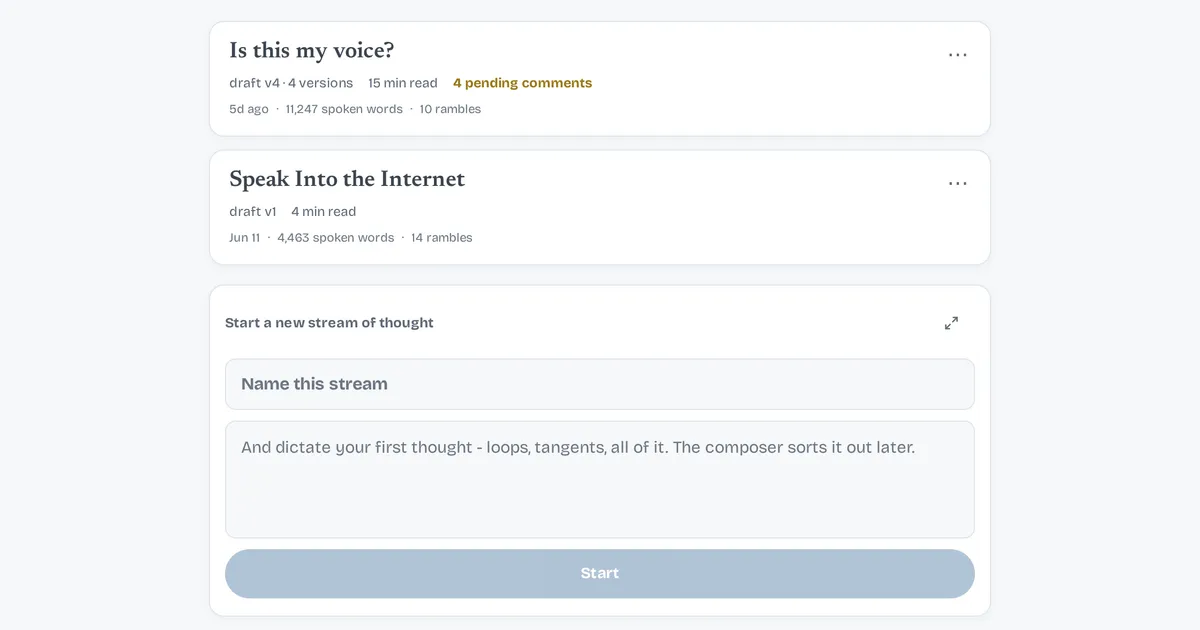
Ramble is a writing tool for people who think out loud. Instead of staring at a blank page, you dictate rambles from your phone and an AI agent acting as the “composer” reads the whole tape and works it into a draft. The catch it takes seriously: the draft has to be your words, with a traceable line back to what you actually said, so it reads like you wrote it rather than like a model paraphrased you.
How it works
The document moves through four artifacts, each versioned independently and each with its own tab:
- Tape. The raw dictation, exactly as transcribed, never edited. Everything downstream has to point back into it.
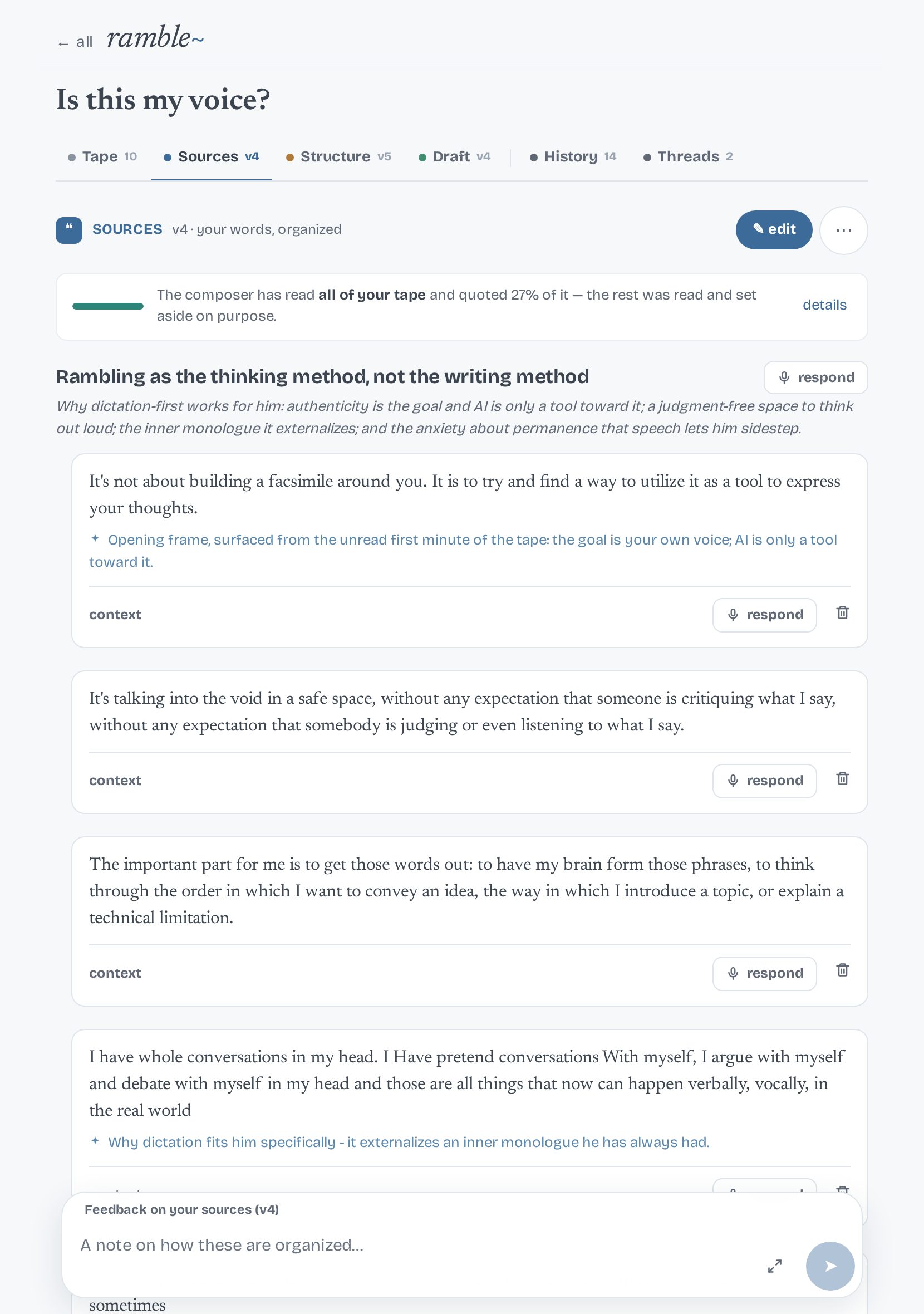
- Sources. Your words, organized: the composer pulls the lines worth keeping out of the tape verbatim and groups them into sections. It chooses what matters and what it’s about; it doesn’t write anything.
- Structure. The meta layer - document type, thesis, scope, tone, audience. What the piece is trying to be, as opposed to what it says. The composer proposes it, you override any field, and saving cuts a new version so the understanding of the piece has a history too.
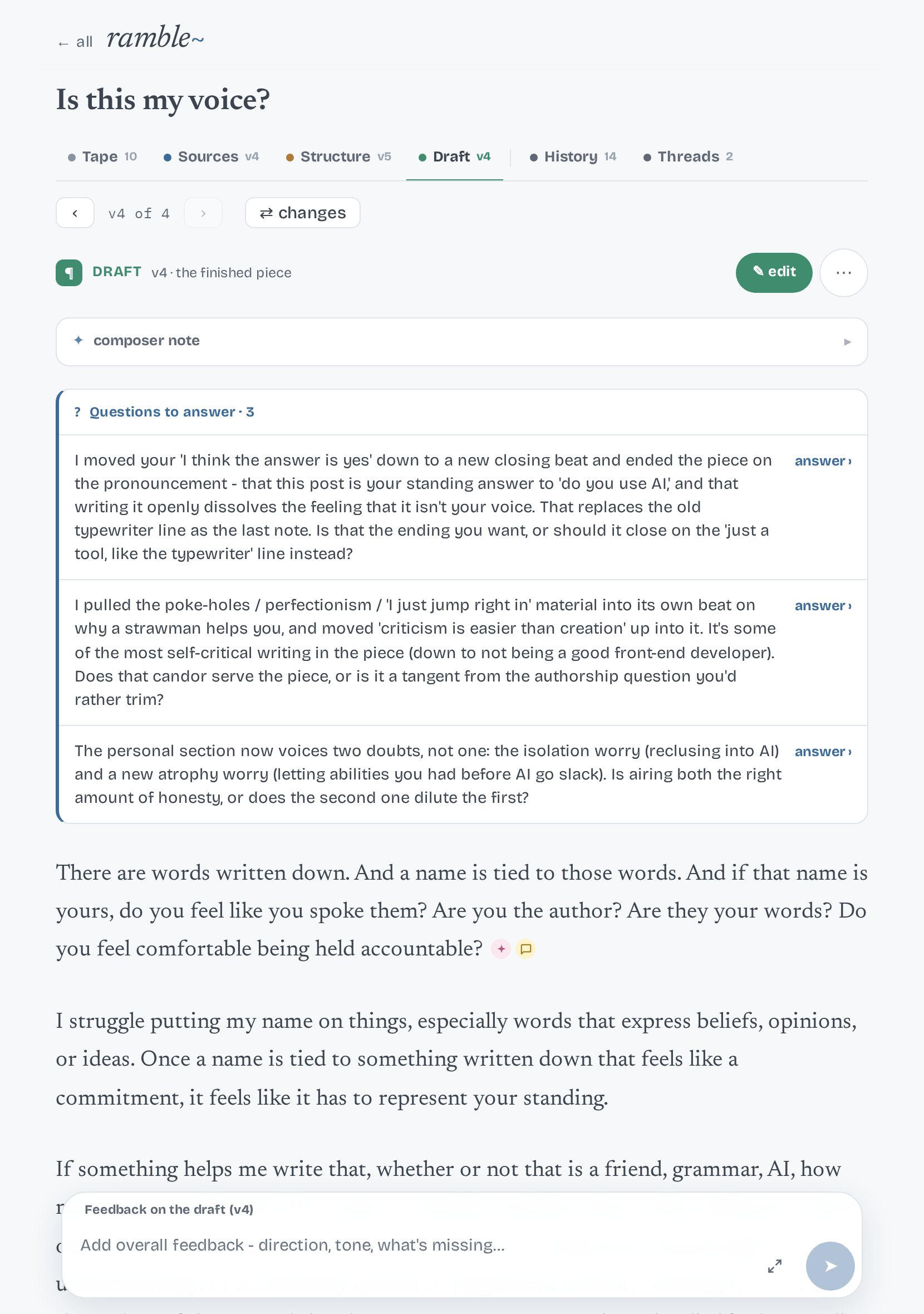
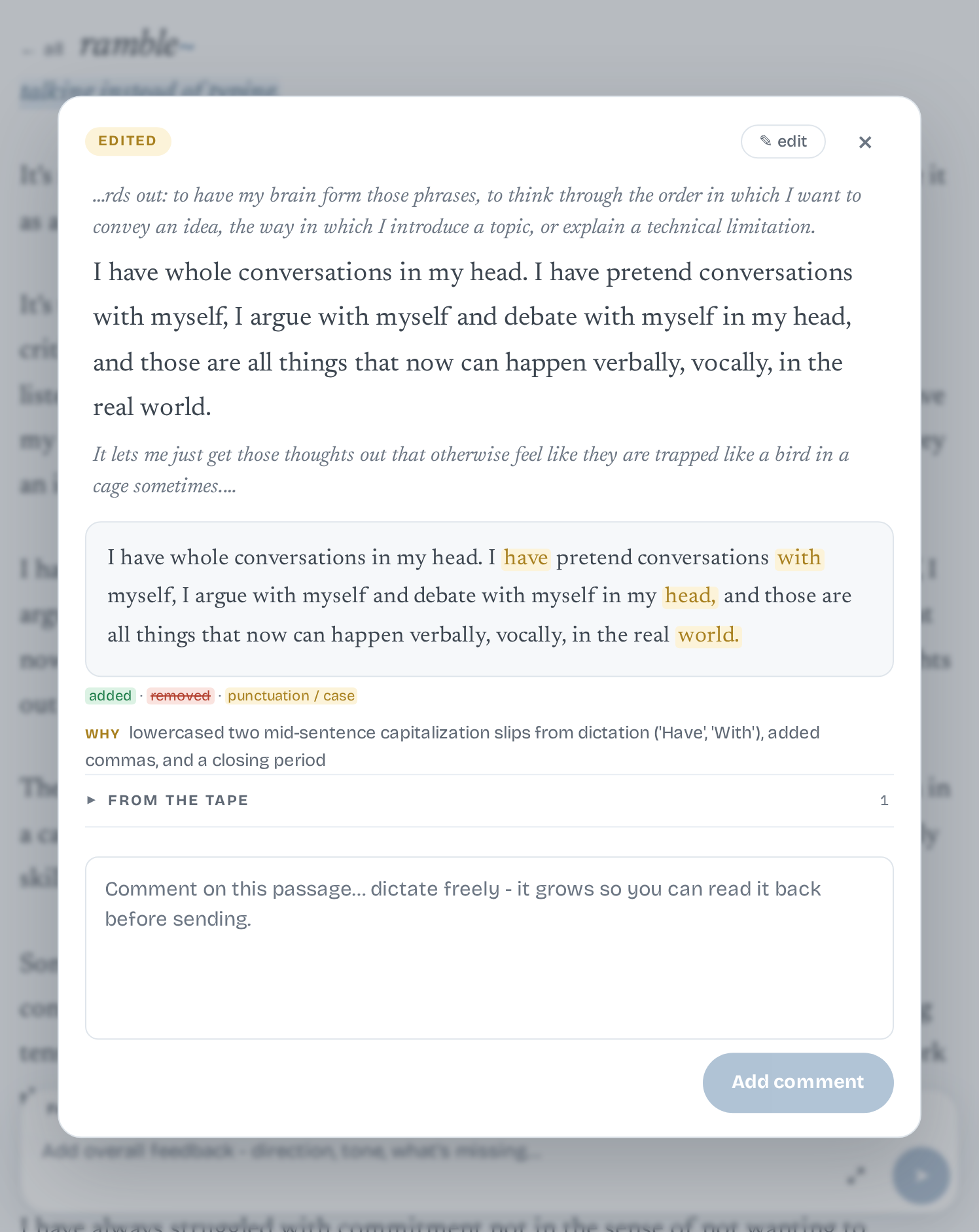
- Draft. The finished prose. Every passage is tagged verbatim, edited, or composer glue, and an edited one carries the exact word diff plus a written reason for the change.
A validation gate runs on every write: a draft whose passages don’t resolve to real spans in the tape is rejected rather than saved. That’s the whole trick - provenance isn’t a convention the model is asked to follow, it’s checked mechanically, so a hallucinated quote can’t land.
The composer also asks questions back. Where the draft is thin or where two things you said contradict each other, it files a question against the passage, and answering is a tap to the mic with the question attached rather than a form to fill in.
Using it
The whole loop is built for a phone in one hand: hit the mic, talk, save. No blank page, no keyboard, no formatting decisions while you’re still thinking. Dictation is written to a local durable queue before it goes anywhere, because the one unrecoverable failure in a tool like this is losing something you said.
Reading the draft works like reviewing a pull request. Passages are tinted by provenance, so the parts that are yours and the parts the model bridged are visible at a glance. Tap one and you get the sentence in context, the word diff, the composer’s reason, and the raw tape with the matching span highlighted. From there you either comment - dictate freely, it grows so you can read it back before sending - or you edit inline, which promotes your typed text to first-class source material and locks it against the composer.
That’s the part worth defending in a design review: you never have to take it on faith that the thing sounds like you. You can see which words are yours, why every change was made, and bounce the draft if the provenance doesn’t check out. The tool’s job is to organize what you said, not to write for you.
Notes
One Go binary serves the API and the embedded React PWA; all state is plain JSON files on disk, no database server. The composer runs as a Claude session on a separate box and writes against the same file contract, so the web server itself makes no model calls - it just owns the files and the validation gate. There’s a second backend that runs the agent loop in-process against the API, for deploys that don’t have a session platform to hand off to.
Screenshots
snapshot
reflects ramble@686ac89captured Aug 18, 2026