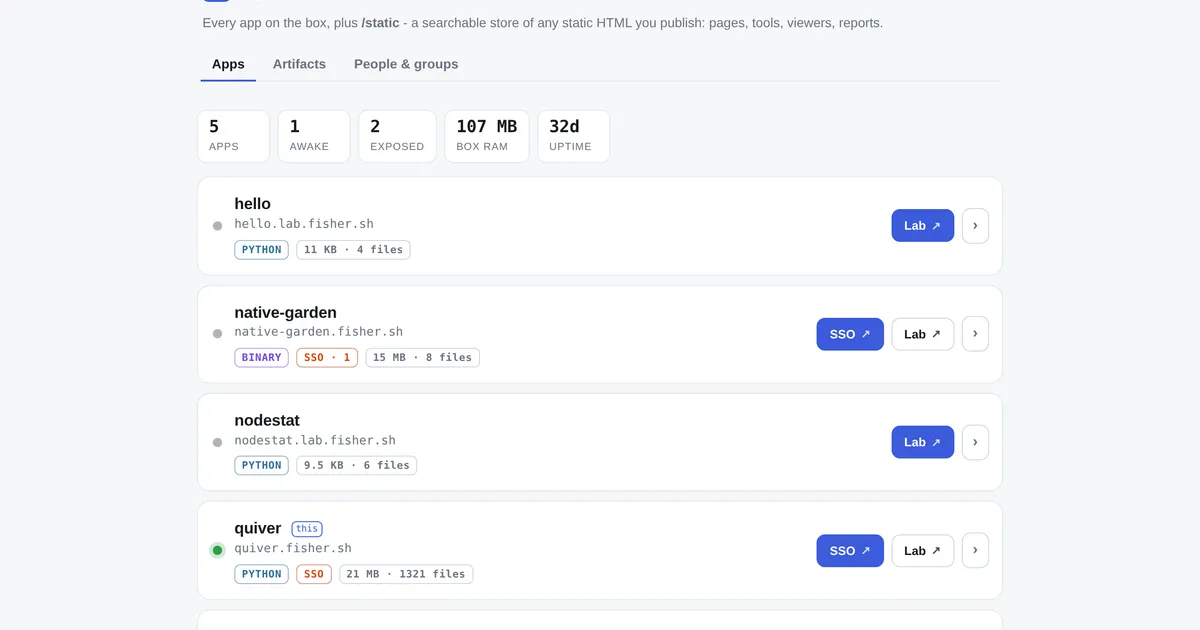
Quiver is the host I built for the pile of small web apps that don’t justify a full Kubernetes deployment - a one-page utility, a report viewer, a 200-line toy. You drop a directory and it gets a working hostname, HTTPS, and its own access rules. The whole point is that an app you hit twice a month should cost nothing the rest of the time.
How it works
- Socket activation, zero idle RAM. A systemd
.socketunit per app owns the listening socket; the app process doesn’t exist until a request arrives. A shared middleware exits the process after an idle window, and the armed socket cold-starts a fresh one on the next hit. At rest the whole box is ~35 MB; each awake app adds ~19 MB. - An app is just a directory. A manifest picks a Python ASGI callable or any
binary (a loopback proxy fronts non-cooperating binaries so they get the same
activation contract), static files are served directly, and one writable
data/path holds SQLite. - Per-app access, reconciled to the edge. Each app declares LAN-only or public-
behind-SSO in its own
access.yaml. A root reconciler makes the CDN match it live - DNS record, tunnel route, and an SSO application whose policy lists exactly who may sign in. - Static artifacts and reports. It also hosts a durable static store with a searchable browser, so generated reports and one-off pages have a single findable home instead of scattering across ad-hoc servers.
Using it
From the operator side the whole appeal is that standing something up costs almost nothing
in effort or in memory. You drop a directory with a small manifest, run one deploy command,
and the app comes up at its own hostname with HTTPS - no repo, no Dockerfile, no CI
pipeline, no route to wire by hand. Because idle apps stop and hold no memory, you never
have to decide whether a tool earns its keep: a dashboard you check twice a month sits
there costing nothing until the next request, so the host quietly accumulates dozens of
them without you managing capacity. Access is a one-file flip - each app’s access.yaml
says LAN-only or public-behind-SSO and exactly who may sign in, and a reconciler makes the
edge match - so sharing a tool with one other person is an edit, not a project. Generated
reports and one-off pages get the same home through a searchable artifact browser, which
means the thing you made for someone to read is findable later instead of scattered across
ad-hoc servers you forgot you started.
Notes
The design decision that carries everything is Restart=no plus a per-app idle-stop:
an automatic restart would defeat idle-stop and pin memory forever. That single
constraint is what lets the host fit dozens of apps in 1 GB.
snapshot
reflects nottingham-cloud@4ce9c28captured Aug 12, 2026