Native Garden
A photo-first browser for planning a native-plant garden on a specific site.
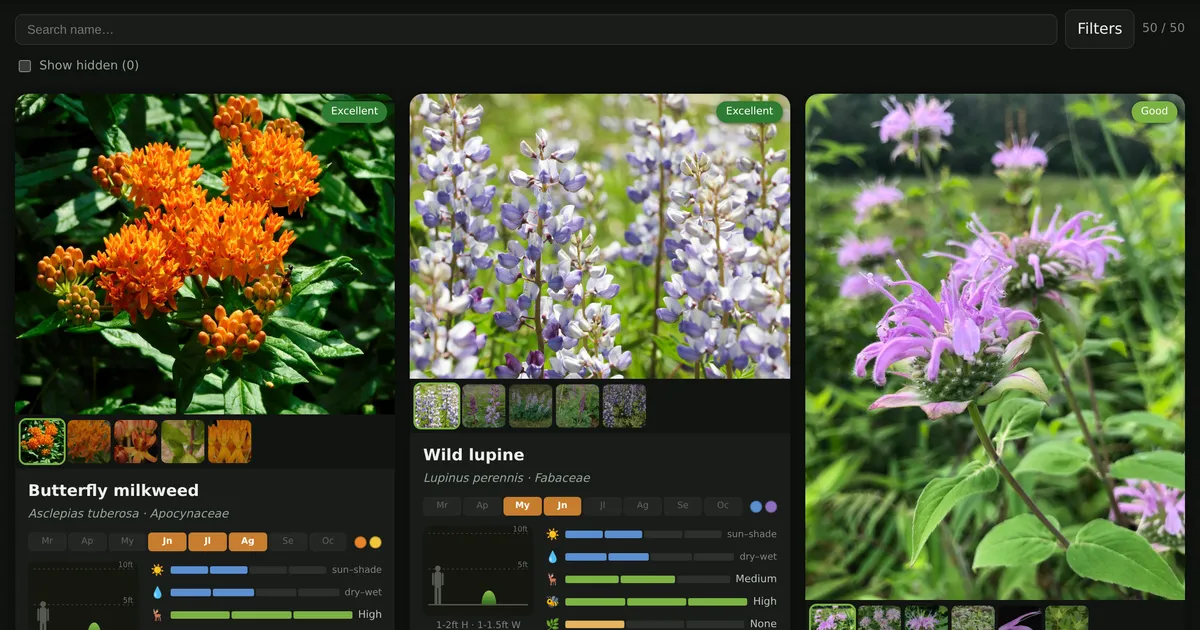
Native Garden is a tool for planning what to plant when you’re replacing lawn with dense native plantings. The catalog is a curated set of ~50 species chosen for one specific site - USDA zone 5a, sandy and dry soil in the northeastern US - so every plant on screen is already a plausible fit. It’s less a plant encyclopedia and more “a spreadsheet you’d actually enjoy using,” with the visual front-end doing the work a spreadsheet can’t.
How it works
- Photo-first browse. A firehose of every plant with a big hero image, plus a 2D shape glyph that draws each plant’s height, spread, and growth habit against a human figure for scale - so you can eyeball an ankle-high mat vs. a shoulder-high grass at a glance.
- Filter on what matters. Bloom month and color, sun and moisture tolerance, deer and pollinator value, lifecycle, site fit, or “no aggressive spreaders.”
- Collections. Pinterest-style boards a plant can belong to many of, each with a bloom-coverage chart across the season so gaps in a “blooms all summer” planting are obvious.
- Compare. Put a handful of candidates side by side with the trait meters aligned so differences read instantly.
Using it
The loop is browse, favorite, compare - closer to shopping than querying a database, on purpose. Planning a bed is a visual, spatial problem: you’re picturing what a corner looks like in July, not reading a table of bloom dates. So each plant leads with a big photo and the scale glyph, because “3 ft spread” means nothing until you see the silhouette against a human figure and realize it’ll swallow whatever you put next to it. The filters cover the decisions that actually gate a choice - will the deer eat it, does it bloom when everything else has stopped, will it take over - not every column in the schema. Collections are boards you drop candidates into, and the bloom-coverage chart is the part a spreadsheet can’t do: it surfaces the two weeks in August where a “blooms all season” planting quietly goes bare. The whole point was to make trait data feel like flipping through a lookbook instead of reading a table.
Notes
One Go binary serves the built React SPA and a small JSON API. The ~50-record catalog is generated, disposable data read at startup; app state - collections, hidden flags, and light-edit overlays - lives in SQLite keyed by a stable plant id, so regenerating the catalog never wipes what you’ve curated. Filtering, compare, and the bloom timeline are all client-side.
snapshot
reflects native-garden@41c03adcaptured Aug 12, 2026